

Don’t miss our Why Guy slideshow all about idioms that come from Greek myths!
Back to Teacher View
Student View
RUSS WILMS
Play,
Pandora's Box
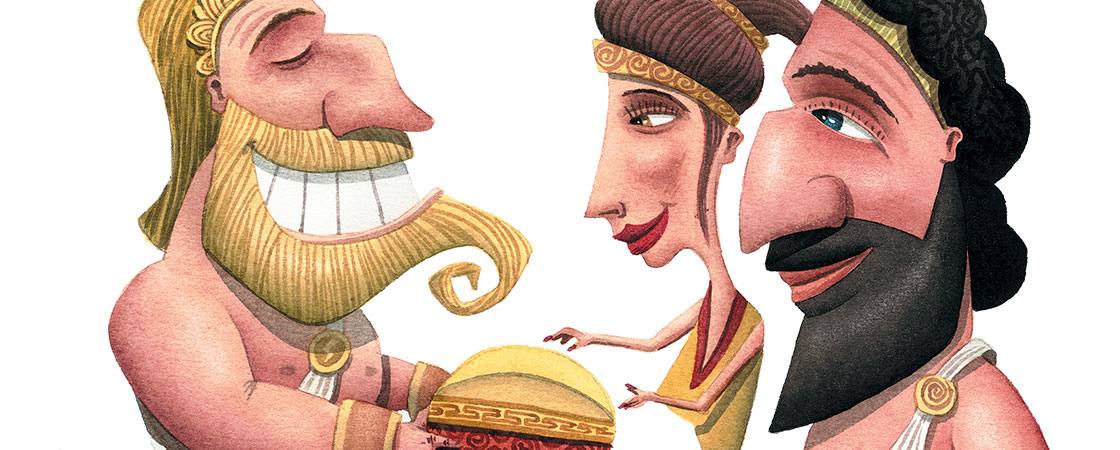
In this Greek myth, Pandora opens a box and changes the world forever.
By By Sari Bodi and Karen Trott
From the September 2018 Issue
Learning Objective: This retelling of a famous myth will help students understand how sequence affects the plot.
Featured Skill:
Theme,
Standards
Activities
(4)
Reading Kit
Skills Activities
Quizzes
(2)
Quizzes
(2)
Answer Key
(1)
Activities
(4)
Download All Quizzes and Activities
Reading Kit
Skills Activities
Quizzes
(2)
Quizzes
(2)
Answer Key
(1)
 Can't-Miss Teaching Extras
Meaning Behind Idioms
More About the Article
Content-Area Connections
self-management (impulse control); relationship skills (teamwork)
Key Skills
sequence, key details, inference, character traits, main idea, vocabulary
Step-by-Step Lesson Plan
1. PREPARING TO READ
Set a Purpose for Reading (10 minutes)
Ask students to look at pages 20-21. Point out the two labels on page 20 (“Play” and “Read-aloud myth”). Explain that a myth is a traditional story first told by storytellers to groups of listeners thousands of years ago. Myths come from all over the world and reveal what people believed about themselves and their world. Some stories taught lessons about how people and animals behave. Others explained events in the natural world, such as the rising and setting of the sun. This play retells an ancient Greek myth. Point out Greece on a map. Ask students to share examples of any myths they know.
Call on a volunteer to read the Think and Read box on page 21 for the class. Ask students to look for details that help them understand the order of events in this play.
Introduce Vocabulary (15 minutes)
Although the play does not include definitions of vocabulary words in the text itself, our vocabulary activity previews challenging words and allows students to list other words that are unfamiliar to them. Project or distribute the activity to review the words. You may also play our Vocabulary Slideshow, which has images and audio to help students with comprehension and fluency.
Challenging words: slither, panic, curiosity, misery
2. FOCUS ON FLUENCY
Bridging Decoding and Comprehension
Storyworks Jr. plays provide a perfect opportunity for students to build fluency.
Point out the directions in italics (e.g., shouting, confused, calling out, growling) and explain that they are included to tell the reader how to say the line. Demonstrate how to use these directions by reading the first two columns of Scene 1. Have students repeat the lines after you.
The play opens with several lines containing ellipses. Explain that the ellipsis at the end of a sentence shows that it is not finished, and one at the beginning shows that the next speaker is finishing the thought.
3. CLOSE READING
Reading and Unpacking the Text
- Before reading: Point out the Characters box on page 21. Demonstrate how to pronounce Zeus, Prometheus, and Epimetheus. Direct students to the text under each scene heading. Explain that these words tell readers where and when each scene takes place. You can also explain that a prologue is an introduction that gives background information that readers need to understand the story. Read aloud the Prologue to the class as students follow in their texts.
- First read: Continue reading the play as a class.
- Second read: Project or distribute the close-reading questions. Discuss them as a class, rereading lines or scenes as necessary.
- Separate students into groups to discuss the critical-thinking questions. Then have groups share their answers with the class.
Close-Reading Questions (30 minutes)
- In Scene 1, what does Zeus want Pro and Epi to do? Why? (key details) He wants Pro and Epi to make animals and humans because Earth is boring without living things.
- In Scene 2, why is Pro so upset? (key detail) Epi gave the animals the long necks, fangs, and fur that his humans need.
- In Scene 3, what does Zeus do after Pro steals his fire? (sequence) To punish Pro, he creates a woman, Pandora, who has beauty, courage, love of music, and curiosity.
- In Scene 4, why does Pro warn Epi and Pandora not to trust Zeus? (inference) He knows that Zeus is angry and is probably going to trick them.
- In Scene 5, why does Zeus’s note say that Pandora should never, ever open the mysterious golden box? (character traits/inference) Zeus knows that Pandora is curious and that telling her not to open the box will make her want to open it and look inside even more.
- At the end of Scene 6, why does the Greek Chorus say “Hope shines a light that’s brighter than Zeus’s fire.” (main idea) They’re explaining that Hope is more powerful than Zeus’s fire.
Critical-Thinking Questions (10 minutes)
- What does Zeus do after Pro gives fire to humans? (sequence) He creates Pandora and gives her curiosity to punish Pro and the humans. What happens next as a result? (sequence) Pandora opens the mysterious box and lets evils into the world.
- Why is it good that Hope came out of the box after the evil forces were let out? (sequence) It’s good because Hope helps people feel better about the bad parts of life.
4. SKILL BUILDING
Exploring Sequence (30 minutes)
- Have students complete the sequence activity. They should also write a response to the Think and Write activity on p. 25.
 Differentiate and Customize
For Small Groups
Divide your class into groups and assign each group a scene from the play. Remind students to pay attention to the directions after a character’s name so they can say each line with the correct emotion. Consider having groups use simple props when they perform their scenes for the class.
For Second Graders
Explain that fluent readers always pause after commas as they read. They also pay attention to periods, question marks, and exclamation points at the end of a sentence. Help students find examples of these punctuation marks in the text. First, read the sentence aloud to the group. Then ask volunteers to read the sentence after you.
For Struggling-Readers
Working with students in a small group, ask them to identify a key event in each scene. Create a sequence-of-events chart with the group. Each event in the chart should begin with a sequence word, such as first, then, next, or last.
For Advanced Readers
Explain that fluent readers always pause after commas as they read. They also pay attention to periods, question marks, and exclamation points at the end of a sentence. Help students find examples of these punctuation marks in the text. First, read the sentence aloud to the group. Then ask volunteers to read the sentence after you.
Text-to-Speech