

The Library of Congress has compiled dozens of Aesop’s fables. Each one is brief and ends with the lesson it illustrates. Some of our faves are The Fox & the Stork and The Ant & the Dove.
Back to Teacher View
Student View
Dave Clegg
Play,
Lion and the Mouse
Can this unlikely pair actually be friends?
By Sari Bodi and Karen Trott
From the March / April 2019 Issue
Learning Objective: Students will identify the moral of a fable as they read this dramatic adaptation of the Aesop story.
Featured Skill:
Character,
Other Key Skills: moral of a fable, character, plot, inference, character’s motivation, vocabulary, compare and contrast
Standards
Activities
(4)
Reading Kit
Skills Activities
Quizzes
(3)
Quizzes
(3)
Quizzes
(3)
Answer Key
(1)
Activities
(4)
Download All Quizzes and Activities
Reading Kit
Skills Activities
Quizzes
(3)
Quizzes
(3)
Quizzes
(3)
Answer Key
(1)
 Can't Miss Teaching Extras
Read This
Teach This
Check out California teacher Kriscia Cabral’s strategy for reader’s theater in our Storyworks Jr. Ideabook, where you can find creative ways to use Storyworks Jr. in your classroom.
More About the Article
Content-Area Connections
ELA: Fables
Social-emotional learning: Self-awareness (recognizing strengths); social awareness (empathy); responsible decision-making (analyzing situations, solving problems); relationship skills (relationship building, teamwork)
Key Skills
Moral of a fable, setting, character, plot, inference, character’s motivation, vocabulary, compare and contrast
Step-by-Step Lesson Plan
1. PREPARING TO READ
Set a Purpose for Reading (10 minutes)
- Look at pages 20-21 with the class. Direct students to the first sentence in the Think and Read box and read it with the class. Explain that fables usually have animals as characters. Invite students to name a fable they have read. Then call on a volunteer to read aloud the Think and Read box on page 21. Ask students to think about the important lesson they will learn in this play by paying careful attention to the relationship between the Lion and the Mouse and how it changes from Scene 1 to Scene 7.
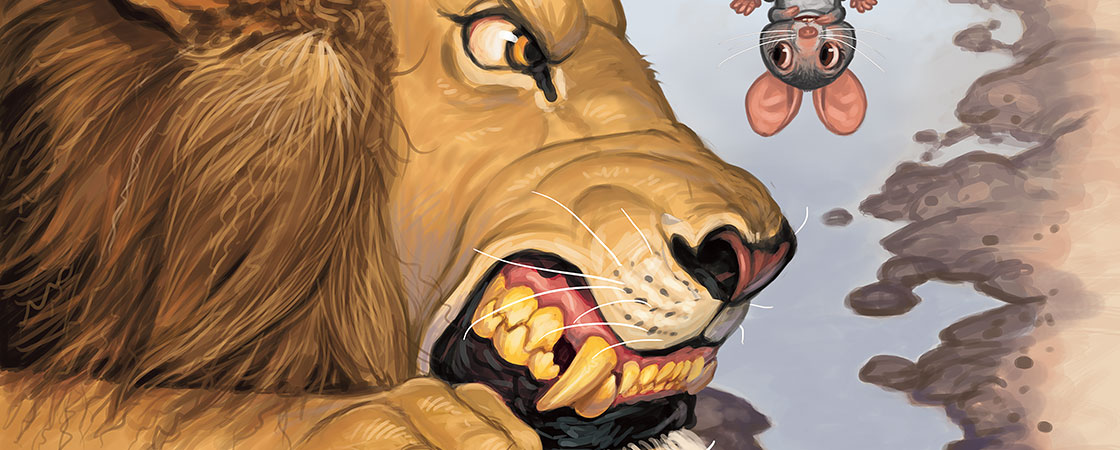
- Read aloud the title and subtitle with the class. Ask students to explain what the illustration shows about Lion and Mouse. How do they feel about each other? Encourage students to answer the question posed in the subtitle.
- Direct students to the illustration on page 24. Ask them to compare it with the one on page 20. How might the relationship between Lion and Mouse change during the play? Write students’ predictions on the board.
Introduce Vocabulary (15 minutes)
- While the play does not include definitions of vocabulary words in the text itself, a vocabulary activity online previews challenging words and allows students to list other words. Project or distribute the activity to review the words. You may also play our Vocabulary Slideshow.
- Challenging words: swoops, boulder, carnivore, capable, stalking, ferocious
2. FOCUS ON FLUENCY
Bridging Decoding and Comprehension
- Storyworks Jr. read-aloud plays provide a perfect opportunity for students to build fluency.
- Remind students that the stage directions in parentheses tell a reader or actor how to say a line or perform an action in the play. Then point to the words pointing and eagerly in column 1 on page 22. Read the dialogue aloud with appropriate expression or action. Have students repeat after you.
- Remind students that fluent readers stop for periods, question marks, and exclamation points. They pause for commas; they read the way they talk to each other.
3. CLOSE READING
Reading and Unpacking the Text
- Before reading: Point to the Characters box on page 21. Ask students to identify the characters in the Mouse family and the Owl family. Point out that most of the characters in this play are animals that speak and act the way people do.
- First read: Continue reading the play as a class.
- Second read: Project or distribute the Close-Reading Questions. Discuss them as a class, rereading lines or scenes as necessary.
- Separate students into groups to discuss the Critical- Thinking Question. Have groups share their answers with the class. (Both Close-Reading and Critical- Thinking Questions are now available in Google Forms on our site, so students can type in their answers and email them to you.)
Close-Reading Questions (30 minutes)
- Where does Scene 1 take place? (setting) It takes place in the Mouse family nest.
- In Scene 1, what does Tiny want her parents to know about her? (character) She wants them to know that she’s fast, isn’t afraid of a dangerous situation, and can surprise them with what she can do.
- In Scene 2, how does Tiny escape when Owl tries to catch her? (plot) She slips into a small crack in the earth. Why is she able to escape this way? (character) She’s so small that she can hide in the tiniest of places.
- In Scene 3, Mama Crocodile whispers to her children, “No fighting, or you’ll scare away your dinner.” What does she mean? (inference) Mama Crocodile is telling her children that if they keep fighting, they’ll make so much noise that Tiny will hear them and run away. Then they won’t be able to eat her.
- In Scene 4, how does Tiny feel when she feels Lion’s breath and sees his sharp teeth? (inference) She feels afraid. Why does Lion decide to let Tiny go rather than eat her? (character’s motivation) Lion sets Tiny free because she makes him laugh. The idea that a tiny mouse could help a strong lion is very funny to him.
- In Scene 5, after she describes everything she’s been through, Tiny says, “Father, maybe I am not as capable as I thought.” Why does Tiny hang her head as she says these words to Father? (inference) She probably feels ashamed.
- In Scene 6, how do the two hunters feel about catching Lion? (compare and contrast) Hunter 1 wants to give up because Lion is too hard to catch, but Hunter 2 wants to lay a trap for him.
- In Scene 7, how does Tiny help free Lion? (plot) She chews at the thick ropes until the net breaks apart. Why does Tiny help Lion escape from the hunters’ trap? (character’s motivation) In Scene 4, she had promised Lion that she would do him a big favor one day if he let her go. This is her chance to return the favor.
Critical-Thinking Question (10 minutes)
- In Scene 7, Tiny rescues Lion and says, “Sometimes even the smallest can help the strong.” What does this mean? (moral of a fable) No one expected a little mouse like Tiny to save Lion. Even if you’re small, you can still be determined and brave. These qualities can enable you to help those who are bigger than you.
4. SKILL BUILDING
Moral of a Fable (30 minutes)
- Have students complete the Moral of a Fable Activity. They should also write a response to the Think and Write question on page 25.
 Differentiate and Customize
For Small Groups
Divide your class into groups and assign each group one scene from the play. To improve fluency, remind students to be aware of punctuation marks and stage directions as they practice their lines. The groups can perform their scenes in class. Videotape or record the performance.
For Struggling Readers
Have students describe what is happening in each illustration. How do Tiny and Lion feel about each other in each picture? Why do they feel this way? Ask pairs to write a caption for each picture and read them aloud.
For Advanced Readers
Ask students to write a paragraph to answer the question: How does Lion change by the end of the play? Students should use details from the play in their paragraphs. They can read aloud and discuss their paragraphs in small groups.
Text-to-Speech