

This 11 ½-minute vintage video gives students a deeper look at Frank Mastro’s story. While it’s not a thrilling video, it is filled with authentic photos illustrating many aspects of our story—and it was posted by Mastro’s grandson!
Back to Teacher View
Student View
ISTOCKPHOTO/GETTY IMAGES
The History of Pizza
Frank Mastro helped turn an Italian meal into an American classic. Never heard of him? Here's his story.

By Anna Starecheski
From the March / April 2019 Issue
Learning Objective: Students will identify problems and solutions in an article about the man who introduced pizza to the U.S. The story is paired with a historical timeline.
Lexiles: 900L-1000L, 700L-800L, 600L-700L
Guided Reading Level: O
DRA Level: 34
Featured Skill:
Problem and Solution,
Other Key Skills: main idea, key details, cause and effect, text features, inference, drawing conclusions, compare and contrast
Standards
Audio
()
Activities
(5)
Reading Kit
Skills Activities
Quizzes
(5)
Quizzes
(5)
Quizzes
(5)
Quizzes
(5)
Quizzes
(5)
Answer Key
(1)
Audio
()
Activities
(5)
Download All Quizzes and Activities
Reading Kit
Skills Activities
Quizzes
(5)
Quizzes
(5)
Quizzes
(5)
Quizzes
(5)
Quizzes
(5)
Answer Key
(1)
 Can't-Miss Teaching Extras
Watch This
Teach This
This text pairing gives you a perfect opportunity to work in a math lesson about fractions. The Pizza Fraction Fun Game is a big hit with students and teachers alike.
Fun Fact
Pizza needs no translation! Swedish people put a sweet spin on their pizza by adding bananas. People in Russia add sardines.
Fun Fact
Get this: The largest pizza in the world weighed 26,883 pounds. The pizza was made in South Africa back in 1990 by Norwood Hypemarket.
More About the Article
Content-Area Connections
Social studies: History, inventions
Science: Technology
Social-emotional learning: Responsible decision-making (solving problems)
Key Skills
Problem and solution, main idea, key details, cause and effect, text features, inference, drawing conclusions, compare and contrast
Step-by-Step Lesson Plan
1. PREPARING TO READ
Explore Text Features/ Set a Purpose for Reading (10 minutes)
- Direct students to the labels on page 10 that say “Paired Texts” and “One topic, two texts.” Ask students to read aloud the title and subtitle on pages 10-11 and the title on page 13. Explain that classic in the subtitle means something that has become well-loved over time. Then ask students to identify the topic of both texts. (the history of pizza in the United States and around the world)
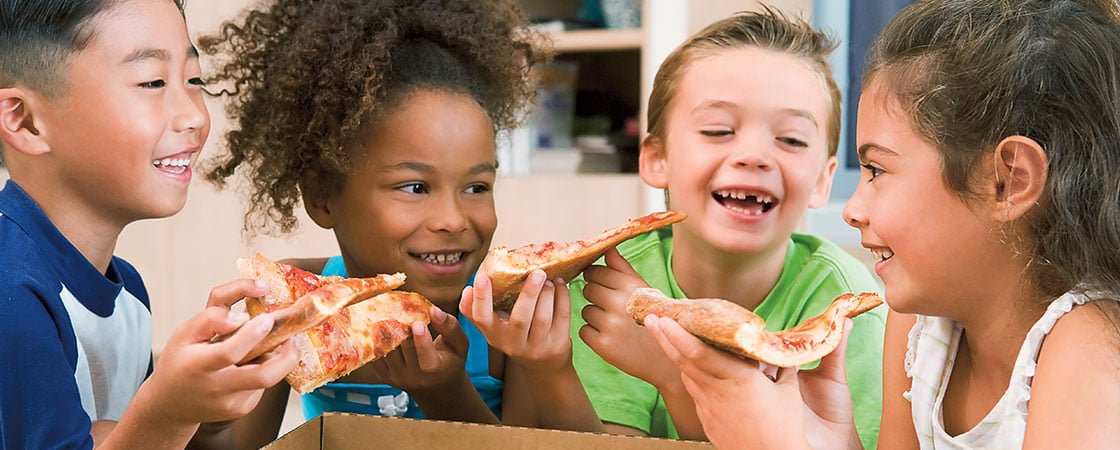
- Ask students to describe what is happening in the photo on pages 10-11.
- Then point to the photo on page 12. Read aloud the caption with the class. Ask why the kids in the picture might feel grateful to Frank Mastro.
- Direct students to the infographic on page 13. Read the label with the class. Explain that an infographic includes information and pictures about a topic. Then read the title with the class. Point to the section header of the first box and read it aloud. Then read the text. Point to Greece on a class map.
- Ask volunteers to read the section headers and text of selected sections. Use the class map to identify the location of the other countries and cities referred to in the infographic. Be sure to point out Italy.
- Call on volunteers to read aloud the Think and Read box on page 11 and the Think and Write box on page 13. As students read each article, remind students to look for details that describe the problems faced by Frank Mastro and how he solved them.
Introduce Vocabulary (15 minutes)
- We have highlighted in bold four words that may be challenging and defined them on the page. Preview these words by projecting or distributing our vocabulary activity and completing it as a class. You may also play our Vocabulary Slideshow.
- Highlighted words: pizzeria, frustrated, loaned, brilliant
2. CLOSE READING
Reading and Unpacking the Text
- First read: Students should read the article and infographic one time for general comprehension.
- Second read: Ask students to read the article and infographic again. Have them identify any detail or vocabulary word they don’t understand.
Close-Reading Questions (20 minutes)
- Read the first section of “The History of Pizza.” What big problem did Frank Mastro face? (main idea) Making pizzas in the 1930s was very difficult.
- Read “Pizza Problems.” What problems did Frank Mastro’s pizza oven solve? (problem and solution) His oven was heated by gas, which was cheaper than coal. It could make many pizzas in minutes rather than hours. Anyone could use his oven. Why wouldn’t Italian bakers buy this new, improved pizza oven? (key details) They didn’t think the pizza would taste good if it wasn’t cooked in the usual way.
- Read “The Pizza King.” Why did Frank Mastro open his Model Pizzeria? (cause and effect) He wanted people to see how fast and easy it was to make delicious pizza in his oven.
- How do the photo and caption on page 12 help you better understand this section? (text features) The photo shows Frank Mastro making pizza with his new oven. It helps readers see why it was faster and easier to make pizzas in this small gas oven.
- Why was Frank Mastro called “The Pizza King”? (inference) His new oven and his ideas about how to open and run a pizzeria increased the number of pizzerias in the United States from 500 to 20,000 over 20 years.
- Read “An All-American Food.” How did Vinnie Mastro improve his father’s business? (key details) He invented frozen pizza dough. Why was his new invention important? (drawing conclusions) It was easy for anyone to make pizzas using frozen dough.
- In “A Pizza Timeline,” read “Pizza Cones.” How were pizzas served at Lombardi’s different from the pizzas we eat today? (compare and contrast) The pizzas were rolled into cones, wrapped in paper, and tied with string for customers to take home. Today, customers either buy flat slices of pizza or take home pizzas in a large, flat box.
Critical-Thinking Question (10 minutes)
- Think about the problems that Frank Mastro faced. Which problem do you think was the most serious? How did he solve it? (problem and solution) Answers will vary but might include: The most serious problem he faced was convincing people to buy his new gas oven. He solved it by opening Frank Mastro’s Model Pizzeria, where everyone could watch a chef making pizza in front of a big window. This showed how fast and easy it was to make pizza. He also included directions for baking a perfect pizza with every oven he sold. Finally, he created a guide that explained how to open and run a pizzeria. Sometimes he even loaned people money to open their own pizzeria.
3. SKILL BUILDING
Putting Ideas Together
- Distribute our Problem and Solution Activity. Have students complete the activity in pairs.
- Discuss the writing assignment in the Think and Write box on page 13. Have students complete their letters in class or as homework. Ask volunteers to read their letters aloud in small groups
 Differentiate and Customize
For Independent Readers
Have students read both texts, looking for details about how and when pizza was made in the U.S. and other countries over time. Have them create an ad that encourages customers to buy pizza in one of these countries.
For ELL Students
Read paragraph 3 in “An All-American Food” while students follow. Help them identify the pizzas made in New York, Chicago, and Hawaii. Discuss whether they eat pizza in their communities and what it is like.
For Struggling Readers
Have students listen to the audio version of the texts as they read. They should underline the dates of important events. Have them create new entries for “A Pizza Timeline,” including numbers, titles, and a picture.
For Advanced Readers
Have students write the first paragraph of a newspaper article about one of the events related to the history of pizza in the story. Remind them to include an exciting headline and interesting first sentence that grabs readers’ attention.
Text-to-Speech