

The Star Wars fans in your class will get a kick out of this 1996 clip of a young boy sharing his figurines with a collectibles expert. (It’s a British show, so explain that a British pound was worth more than $1 U.S. dollar.)
Back to Teacher View
Student View
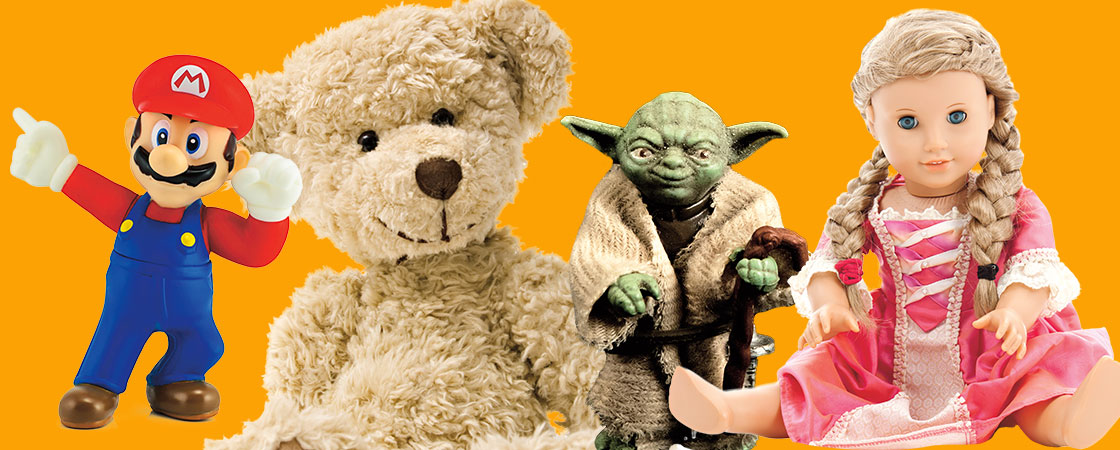
NICESCENE/SHUTTERSTOCK.COM (MARIO); GONZALES PHOTO/ALAMY STOCK PHOTO (YODA); ISTOCKPHOTO/GETTY IMAGES (ALL OTHER IMAGES)
Toys or Treasures?
Some toys get more valuable as they get older. Does this mean your old stuffed animals are worth thousands of dollars?
By Tod Olson
From the February 2019 Issue
Learning Objective: Students will put ideas together from related articles about the financial and emotional value of our prized possessions.
Lexiles: 800L-900L, 500L-600L, 400L-500L
Guided Reading Level: N
DRA Level: 28
Featured Skill:
Compare and Contrast,
Other Key Skills: Putting ideas together, compare and contrast, author’s point of view, main idea, drawing conclusions, cause and effect, summarizing, key details
Standards
Audio
()
Activities
(5)
Reading Kit
Skills Activities
Quizzes
(3)
Quizzes
(3)
Quizzes
(3)
Answer Key
(1)
Audio
()
Activities
(5)
Download All Quizzes and Activities
Reading Kit
Skills Activities
Quizzes
(3)
Quizzes
(3)
Quizzes
(3)
Answer Key
(1)
 Can't-Miss Teaching Extras
Vintage Finds
Visit Superman’s Home!
Take your students on a kid-led virtual tour of the DC Comics headquarters and see their rare comics and collectibles up close.
More About the Article
Content-Area Connections
Social studies: U.S. history, inventions
Social-emotional learning: Responsible decisionmaking (analyzing situations, evaluating, reflecting)
Key Skills
Putting ideas together, compare and contrast, author’s point of view, main idea, drawing conclusions, cause and effect, summarizing, key details
Step-by-Step Lesson Plan
1. PREPARING TO READ
Preview Text Features/ Set a Purpose for Reading (10 minutes)
- Direct students to the labels on page 10 that say “Paired Texts” and “One topic, two texts.” Ask students to read aloud the title and subtitle on pages 10-11 and the title on page 13. Then ask students to identify the topic of both texts. (what makes personal possessions valuable to their owners)
- Read aloud the label on page 13. Explain that writers often express their personal feelings about something in an essay.
- Ask students to identify the toys in the photos on pages 10-12. Then read aloud the price tags in the photos on page 12 with the class. Which toy is more valuable?
- Point to the photos on page 13. Call on a volunteer to read aloud the caption. Ask students to describe each photo. Have students predict what “priceless treasure” Lauren Tarshis writes about in this essay.
- Call on volunteers to read aloud the Think and Read box on page 11 and the Think and Write box on page 13. As students read each article, remind them to look for details that explain what makes an object valuable to its owner.
Introduce Vocabulary (15 minutes)
- We have highlighted in bold three words that may be challenging and defined them on the page. Preview these words by projecting or distributing our vocabulary activity and completing it as a class. You may also play our Vocabulary Slideshow, where images and audio help students with comprehension and fluency.
- Highlighted words: collectibles, packaging, valuable
2. CLOSE READING
Reading and Unpacking the Text
- First read: Students should read each article one time for general comprehension.
- Second read: Ask students to read the article and essay again. Have them identify any detail or vocabulary word they don’t understand in each section.
Close-Reading Questions (20 minutes)
- Read the first section. Was the Luke Skywalker action figure more valuable in 1978 or in 2015? (compare and contrast) It was more valuable in 2015. In 1978 it cost $2.49; however, in 2015, someone paid $25,000 for it.
- Why does the writer of this article describe toy collecting as “wacky”? (author’s point of view) The writer thinks it’s crazy that some toys are worth so much more money over time.
- Read “Treasure Hunt.” Why do toy collectors buy toys? (main idea) Toy collectors buy toys because they hope the toys will be worth a lot of money in the future.
- Read “Now and Then.” Why do special LEGO® sets cost so much money? (drawing conclusions) These special sets are made only for toy collectors to buy.
- Read “Why People Collect.” Why are the Luke Skywalker toy and the Roller Beach Bomb van so valuable? (cause and effect) There were problems with these toys, so the companies stopped making them and now there aren’t many left.
- What are some reasons that people collect old toys? (summarizing) People hope the toys will be worth money, or they want to feel as if they are a part of history. Some collectors love hunting for a rare toy because they think the toy will bring back happy memories.
- Read “My Priceless Treasure.” What did Lauren Tarshis find out about her grandmother’s gift when she tried to buy a new chain? (key details) The heart-shaped locket that she thought was gold was fake gold. It wasn’t worth much money. Why does she still describe the heart-shaped locket as “priceless”? (author’s point of view) She considers the locket to be very valuable because it was a gift from her grandmother. The locket helps her remember her grandmother’s love for her.
Critical-Thinking Question (10 minutes)
- Think about both articles. What makes both the heart-shaped locket and the collectible toys valuable to their owners? (putting ideas together) People collect toys because they bring back happy memories. Similarly, Lauren Tarshis values her locket because it reminds her of her grandmother.
3. SKILL BUILDING
Putting Ideas Together
- Distribute our Putting Ideas Together Activity. Have students complete the activity in pairs.
- Discuss the writing assignment in the Think and Write box on page 13. Remind students to use the first-person pronoun “I” in their personal narrative. Have students complete their personal narratives in class or as homework. Ask volunteers to read their personal narratives in small groups.
 Differentiate and Customize
For Reading Partners
Have pairs of students read the articles silently. Then ask students to make up three questions they would ask toy collectors about why they collect old toys. Kids can read their questions aloud in small groups.
For Guided Reading Groups
Read the articles together in your guided reading group. Ask students to underline details in both stories that describe why certain objects are important to their owners. Would students recommend the articles to a friend? Why or why not?
For Struggling Readers
Have students read the lower- Lexile version as they follow along with the lower-Lexile audio. Pause at the end of each section to answer students’ questions.
For Advanced Readers
Ask students to think of one of their own toys that they believe will become valuable over time. Have them write a paragraph describing what the toy looks like and why future toy collectors might like it. Kids can read their paragraphs aloud.
Text-to-Speech