

Show your students this short video of Laura Ingalls’ birthplace in Pepin, Wisconsin! This video shows her first “little house,” a wooden log cabin.
Back to Teacher View
Student View
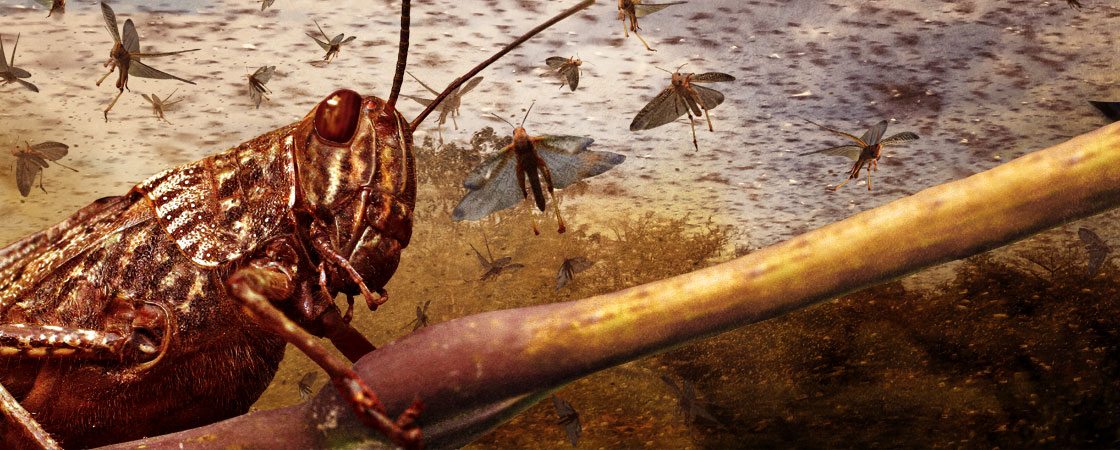
Art by Shane Rebenschied; Ingo Arndt/Getty Images (background); PaoloBis/Getty Images (grasshopper); Protasov AN/Shutterstock.com (flying locusts)
Swarms of Terror
In the late 1800s, grasshoppers destroyed the farms of many American pioneers.

By Lauren Tarshis
From the February 2019 Issue
Learning Objective: In this narrative nonfiction article, students read about the Rocky Mountain locusts that destroyed prairie farmland in the late 1800s. Readers learn the importance of author’s craft by identifying descriptive details, which bring this long-ago ecological disaster to life.
Lexiles: 700L-800L, 600L-700L, 500L-600L, Beginner
Guided Reading Level: O
DRA Level: 34
Featured Skill:
Author's Craft,
Other Key Skills: setting, key details, author’s craft, text features, descriptive details, cause and effect, inference
Standards
video
(1)
Audio
()
Activities
(7)
Reading Kit
Skills Activities
Quizzes
(3)
Quizzes
(3)
Quizzes
(3)
Answer Key
(1)
video
(1)
Audio
()
Activities
(7)
Download All Quizzes and Activities
Reading Kit
Skills Activities
Quizzes
(3)
Quizzes
(3)
Quizzes
(3)
Answer Key
(1)
 Can't-Miss Teaching Extras
Where is Laura’s house?
More on Locusts
This BBC Earth video is packed with facts (adults locusts eat their body weight every day) and the sounds of the swarms alone will have your students glued to the screen.
Making Connections
Help your students understand how the pioneers had to provide for themselves. For instance, the standard cure for a chest cold was to rub the chest with goose grease and a spread made of mustard!
Fun Fact
The Rocky Mountain locusts that attacked the prairie are now extinct. The last one was spotted in Canada in 1902.
More About the Article
Content-Area Connections
Social studies: U.S. history, geography
Science: Ecology, environment
Social-emotional learning: Relationship skills (teamwork)
Key Skills
inference, key details, cause and effect, figurative language
Step-by-Step Lesson Plan
1. PREPARING TO READ
Watch a Video/Preview Text Features (25 minutes)
- Direct students to the title, subtitle, and photograph on pages 4 and 5. Ask students to predict what the story is about. Ask: What do you imagine when you read the title? What important details does the subtitle tell you about the insect swarms? How does the photograph help you imagine what it was like to live through a grasshopper attack?
- Ask students to identify the Ingalls farm on the map on page 7. Help students use the map legend to identify states that were hard hit and hardest hit by the grasshopper attacks. In which area was the Ingalls family farm?
- Read aloud the captions and look at the photos on the next two pages. Ask: How did farm families work together to try to save their farms from the locusts?
- Point to the graphic on page 8. Read aloud the title and captions with the class. Ask: How are grasshoppers and locusts the same? How are they different?
Introduce Vocabulary (15 minutes)
- We have highlighted in bold eight words that may be challenging and defined them on the page. Preview these words by projecting or distributing our vocabulary activity and completing it as a class. You may also play our Vocabulary Slideshow, where images and audio help students with comprehension and fluency.
- Highlighted words: settled, pioneers, pitchforks, eerie, bulging, swarm, drought, crops
Set a Purpose for Reading (5 minutes)
- Call on volunteers to read aloud the Think and Read and Think and Write boxes on pages 4 and 9. These support the story’s featured skill, author’s craft. As they read, ask students to look for descriptive details that help them imagine what happened during a locust attack.
2. CLOSE READING
Reading and Unpacking the Text
- First read: Read the story as a class. Ask students to identify any vocabulary words or details they don’t understand in each section.
- Second read: Distribute the Close-Reading and Critical-Thinking Questions to the class. Preview them together. Ask students to read the article again and answer the questions as a class or in small groups.
Close-Reading Questions (30 minutes)
- Read the first section. How does Laura Ingalls feel when she sees the shadow in the sky? (inference) She feels worried, because she knows that something terrible is happening. What descriptive details help you imagine what the shadow looked like to Laura? (author’s craft) The author says that the shadow “shimmered strangely” in the sky.
- Read “Snipping Scissors.” What descriptive details does the author use to help you understand how the cloud sounded to Laura? (author’s craft) Laura hears strange and scary sounds (whir, click, and buzz) coming from inside the cloud. How does the author help you understand how loud these sounds were? She compares them to the sound of “thousands of giant scissors snipping at the sky.”
- What did Laura do to protect herself from the insects? (key details) She tried to swat them away from her ears and eyes. She closed her lips to keep them from flying into her mouth.
- Read “Millions of Chomping Jaws.” How did the locust swarm affect the lives of prairie farmers? (cause and effect) The locusts destroyed farms in many states. The insects ate crops, such as wheat, vegetables, and fruit, which farmers needed to survive.
- Read “Chewed to Nothing.” What does the author mean when she writes “the locusts stuck to the wheat like glue”? (figurative language) Glue holds things together very firmly. Because the locusts were attached so firmly to the wheat, nothing the farmers did could drive them away from the crops.
- How do you think Laura’s mom felt after trying to save the family’s vegetables by covering them with quilts? (inference) She may have felt sad because the bugs chewed through the quilts and ruined the plants, and worried because she couldn’t stop the locusts.
- Why did the author choose the subhead “Rotting Bugs” for the next part of the story? (author’s craft) This section describes how the dead locusts polluted the environment. Because the insects’ bodies filled wells and ponds, the water was too foul to drink. Rotting locusts covered the ground and produced a horrible, long-lasting odor.
Critical-Thinking Question (10 minutes)
- How does the author’s use of descriptive details help you imagine Laura’s feelings during the locust attack? (author’s craft) The descriptive details tell readers how frightening the locust cloud looked and sounded. The author says it “shimmered strangely in the sky.” Laura compares the sounds made by the locusts to “giant scissors snipping at the sky.” Other details describe what happened when the insects attacked her by buzzing in her ears, crawling across her eyes, and flying into her mouth.
3. SKILL BUILDING
- Distribute our Author’s Craft Activity. Have students work with a partner.
- Discuss what’s in the Think and Write box on page 9. Ask students to look at pictures from the story to help them describe the attack. Have them include details that tell how something looks, feels, sounds, tastes, and smells.
 Differentiate and Customize
For Small Groups
Have students read the story silently. Ask them to find details that describe when Laura saw the cloud, when the locusts attacked her, and when they covered the field. Discuss why she never forgot the attack.
For Struggling Readers
Have students listen to the lower-Lexile audio while reading the lower-Lexile text. Ask them to underline details that tell how the grasshoppers looked, sounded, and smelled. Have them choose a detail to use in the first sentence of the Think and Write activity.
For ELL Students
Read aloud the paragraph on page 7 that describes a swarm of grasshoppers attacking Laura. Ask students to mimic each action described in the paragraph. Have them talk about how Laura felt as millions of bugs attacked her.
For Advanced Readers
Ask students to write a four-line poem about a locust attack on a prairie farm. Remind them to use descriptive details to make the sight, sound, taste, feel, or smell of the insect swarm come alive. Students can read their poems aloud in a small group.
Text-to-Speech