

Your students will be blown away by what television looked like back in the day. This short clip was recorded in 1939 by filming a TV screen with a camera. It’s a far cry from our high-definition TVs today! Note that while this video has no sound, the show being recorded did have sound.
Back to Teacher View
Student View
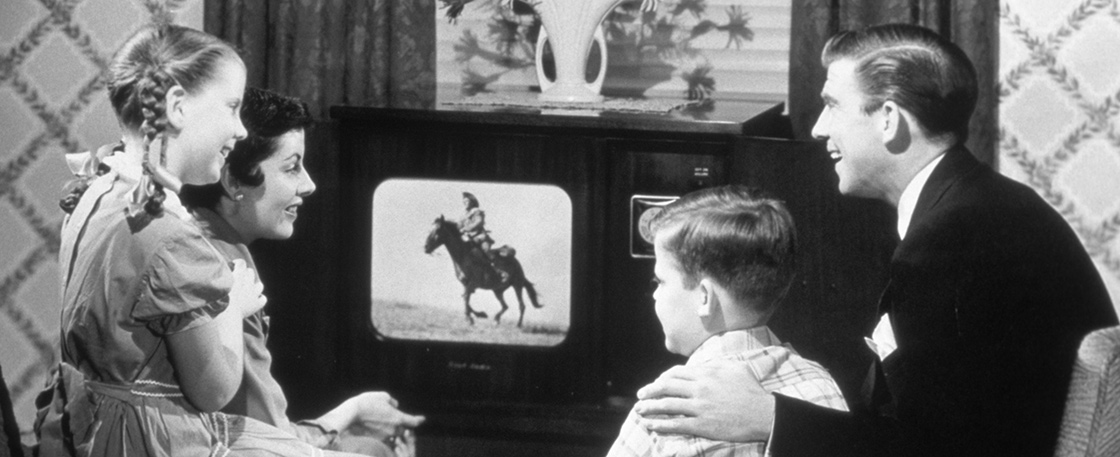
EWING GALLOWAY/CLASSICSTOCK/EVERETT COLLECTION
The History of Television / Television Transformed
Students will learn about the history of television as they compare and contrast changes in technology and viewing habits.

By Lauren Tarshis
From the December 2017 / January 2018 Issue
Learning Objective: Students will learn about the history of television as they compare and contrast changes in technology and viewing habits.
Lexiles: 570L, 660L
Guided Reading Level: N
DRA Level: 28
Featured Skill:
Compare and Contrast,
Standards
Audio
()
Activities
(4)
Download All Quizzes and Activities
Reading Kit
Skills Activities
Quizzes
(1)
Answer Key
(1)
 Can’t-Miss Teaching Extras
Low-Definition
Change in Appearance
The infographic in this article shows how the TV’s appearance has changed 1928 to 2007.
The First Clicker
In 1950, a company named Zenith Radio Corporation created the very first television remote control named Lazy Bones. It was connected to the TV by an extremely long cable wire, which annoyed many customers because they’d always trip over the cord.
Fewer Options, More Quality Time?
These paired texts can spark a meaningful discussion. Ask students: Would you have preferred to live during the time when families were more likely to watch shows together, and when there weren’t as many options of what to watch?
Radio Stars
Your students might be wondering what families did together before television. One popular pastime was listening to the radio. Back then, programs similar to TV shows played on the radio and families would gather around to listen to their favorite shows together.
More About the Article
Content-Area Connections
social studies: U.S. history
science: technology, inventions
Key Skills
compare and contrast, main idea, author’s craft, key details, cause and effect, text features
Step-by-Step Lesson Plan
1. PREPARING TO READ
Explore Text Features/ Set a Purpose for Reading (10 minutes)
• Have students look at the spreads on pages 10-11 and 12-13. Ask volunteers to read aloud the title and subhead of both articles. Then ask students what the one topic of both articles is. (how television has changed over time)
• Point to the photos on pages 10 and 12. Ask students to describe what is happening in each one. To direct discussion, ask how the kids in each image are watching television.
• Call on volunteers to read aloud the Think and Read box on page 11 and the Think and Write box on page 13. As they read the articles, remind them to look for the ways that watching television has changed over time.
Introduce Vocabulary (15 minutes)
• We have highlighted in bold the six words that may be challenging for students and defined them on the page. Preview these words by projecting or distributing our vocabulary activity and completing it as a class.
• Highlighted terms: invention, technology, miracle, dedicated, culture, rural
2. CLOSE READING
Reading and Unpacking the Text
• First read: Students should read each article one time for general comprehension.
• Second read: Distribute the close-reading and critical-thinking questions. Preview them as a class.
• Have students read the story again, as a class or in small groups, pausing to answer the questions.
Close-Reading Questions (20 minutes)
• Read the first section of “The History of Television.” What event does the author describe? (main idea) The author describes the delivery of a television set to the Ross house. How does the author make you feel as if you’re watching TV with the Ross family? (author’s craft) She uses Karen Ross’s own words to describe her memory of watching television with her family.
• In the section “Bigger Screens,” what was it like to watch the very first television sets? (key details) The screens were very small. The black-and-white picture was hard to see. There weren’t many different kinds of shows. How did televisions get better over time? (compare and contrast) Screens became larger and sets cost less money. The picture was clearer and in color.
• Read the section “Family Favorites.” How did television bring Americans closer together? (main idea) People in big cities and small towns watched the same programs. How did watching television change children’s lives? (cause and effect) They played outdoors less. Children watched programs such as Sesame Street, Star Trek, and cartoons on Saturday morning.
• In “Television Transformed,” read the section “Changed by Technology.” How did cable TV change television in the 1980s? (cause and effect) Cable TV added many more shows and channels. Some new channels have shows about just one subject.
• How do we watch our favorite television programs today? (main idea) We watch programs wherever we want and on different devices. How does the photo on pages 12-13 connect to what you just read about watching TV programs today? (text features) The photo shows a group of kids watching programs or videos on different devices in their hands.
• How might so many different TV programs divide our country? (main idea; key details) People in different parts of the country watch different programs. Also, they watch news programs that have different points of view.
Critical-Thinking Question (10 minutes)
• Think about both texts. How did families watch TV when it was new? How do they watch TV today? (compare and contrast) Families used to watch their favorite shows together on a TV set at home. Today, family members watch different programs and videos separately, on individual devices, whenever and wherever they want.
3. SKILL BUILDING
Connecting Texts
• Distribute our compare and contrast activity sheet. Have small groups of students complete the activity.
• Discuss the writing assignment in the Think and Write Box on page 13. Have students complete the task in class or as homework. Ask volunteers to read their paragraphs aloud in small groups.
 Differentiate and Customize
For Independent Readers
Have students read the articles on their own. Ask them to pay attention to the ways TV has brought people together and divided us. Then ask students to create an ad from the 1960s, the 1980s, or today that encourages people to watch TV. Their ads should include a sentence with info about the TV-viewing experience and a picture. Invite students to talk about their ads in small groups.
For Reading Partners
Have pairs of students read the articles silently. Then ask students to take turns role-playing an interview with a student who watched television when it was new and an interview with a student who watches television today. Partners can play both interviewer and subject. Invite student pairs to present one of their interviews in small groups.
For Struggling Readers
Read the article aloud, as students follow along with their stories. As you read, ask students to circle or mark with a sticky note key events in the history of television from the 1940s to today. Pause at the end of each section or article to ask students what they marked.
For Advanced Readers
After reading the article, ask small groups of students to discuss how television affected Karen Ross’s family and Ella’s family. Then ask students to either write a diary entry from Karen or a blog from Ella about a night at home watching TV. Have students share their diary entries or blogs with their groups
For On Level Readers
Think And Write
How is watching TV today different from the way it was in the past? Answer in two well-organized paragraphs, using details from both texts.
Text-to-Speech