

This story provides a message that it’s important to mean what you say. Start a class discussion about this message. Ask: What’s another situation in which it’s important to speak carefully?
Back to Teacher View
Student View
SEBASTIA SERRA
Like Magic
In this entertaining tale, students will understand how a series of events teaches the main character about the importance of family and the power of love.
By Lauren Magaziner
From the October / November 2017 Issue
Learning Objective: In this entertaining tale, students will understand how a series of events teaches the main character about the importance of family and the power of love.
Lexiles: 510L, 600L
Guided Reading Level: M
DRA Level: 24
Featured Skill:
Plot,
Topic:
Social Issues,
Standards
Audio
()
Activities
(5)
Download All Quizzes and Activities
Reading Kit
Skills Activities
Quizzes
(1)
Answer Key
(1)
 Can’t-Miss Teaching Extras
Class Discussion
See the Legend in Action
Your students will love this old clip of legendary magician Harry Houdini performing his signature strait jacket escape back in the early 1900s.
Extension Activity
For a fun extension activity that deepens SEL, try this teacher’s advice column idea! Have students write an advice column to Jonah at the beginning of the story. How can he deal with his feelings about his family?
Dealing with Family
Discussion point: Ask your students if they’ve ever felt frustrated with their families. How did they get through it? What did they learn about family and conflict from this story?
More About the Article
Key Skills
Plot, vocabulary, inference, key details, text evidence, how a character changes, theme
Step-by-Step Lesson Plan
1. PREPARING TO READ
Preview Text Features (10 minutes)
Direct students to the illustration on page 15, and invite them to study it. Ask: Where does the boy seem to be going? What do you think he might find inside the house? Point out the subheads and the Pause and Think boxes at the end of each section. Explain that the questions in these boxes will help the students better understand the story.
Set a Purpose for Reading
We have created a fiction package that helps students focus on one important aspect of the story—in this case, plot. The tasks in the Think and Read and Think and Write boxes work together to support this skill focus. Have one student read the task in each box.
Read aloud the first Pause and Think box on page 14. These questions will check basic comprehension. (Students will delve into higher-level work with the close-reading questions, available here and online.)
Introduce Vocabulary (15 minutes)
This story includes five vocabulary words highlighted in bold: mansion, blurted, teetering, chandeliers, and muttering.
The words are defined at the bottom of the column in which they appear. Discuss the meanings of the words, looking at how they are used in the story to help students understand them.
Distribute our vocabulary activity for more practice with these words. You can also play our interactive Vocabulary Slideshow.
2. CLOSE READING
Reading and Unpacking the Text
First read: Students should read the story one time for general comprehension. Whether your students read as a class, in small groups, or independently, ask them to answer each of the Pause and Think questions throughout the story.
Second read: Distribute the close-reading and critical-thinking questions. (For struggling readers, you can distribute the sheet of Pause and Think questions.) Preview them as a class.
Have students read the story again, pausing to answer the questions.
Close-Reading Questions (30 minutes)
- Read “Jonah’s Wish.” What led Jonah to the magician’s mansion? (plot) Jonah had a bad fight with his younger sisters. His parents blamed him for the argument. This made him so angry that he ran all the way up the hill that led to the magician’s home.
- In the same section, what does Jonah do that makes him a “foolish boy”? Hint! Read the section “Kicked Out” to help you answer. (plot) When Jonah gets very angry, he makes a wish that gives a sneaky magician the chance to steal his family.
- What details in “A Chance to Do Magic” offer hints that the magician might be a villain? (inference; key details) The author describes the magician as a pale, wrinkled man with teeth as sharp as icicles and eyebrows like caterpillars. He lives alone in a creepy, cobweb-filled old mansion on a mountaintop.
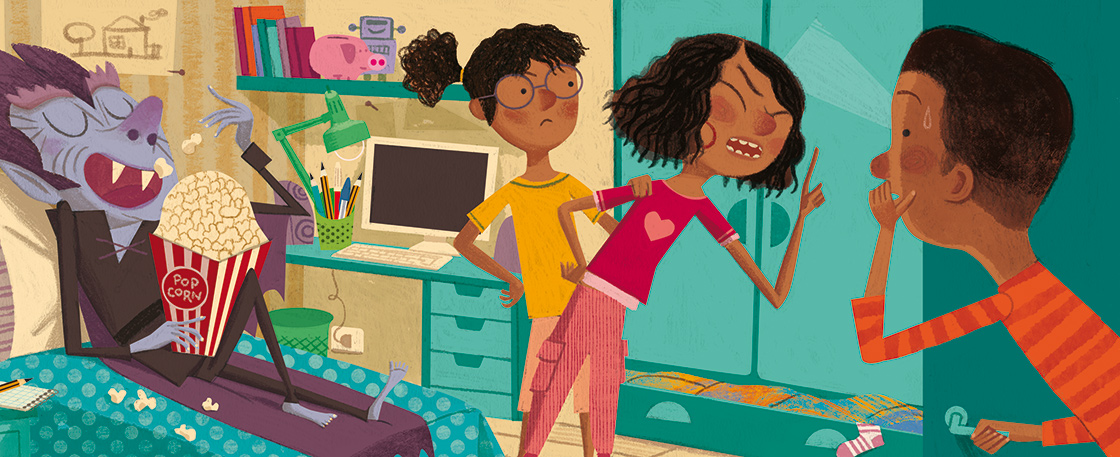
- In “A Nasty Surprise” and “Kicked Out,” how does Jonah know that the magician has taken his place? (text evidence) First, he finds the magician relaxing in his room, on his bed! Then Jonah’s sisters point at the magician and call him their brother. Finally, Jonah’s father looks lovingly at the magician before kicking Jonah out of his own home.
Critical-Thinking Question (10 minutes)
- What do you think Jonah learns from the events of this story? (theme) Jonah realizes that he does not want his family to disappear, even if they make him angry sometimes. He also learns that he shouldn’t say things he doesn’t mean.
3. SKILL BUILDING
How a Character Changes
Call on a volunteer to read aloud the Think and Write box at the bottom of page 19.
Distribute our Fiction Reading Kit, which focuses on key reading skills, including our featured skill, character. Have students work in small groups to complete it.
 Differentiate and Customize
For Independent Readers
Have students write a review of the story and tell why they would or would not recommend it to a friend. Ask them to be sure to use details from the story in their review.
For Small Groups
Using sticky notes, students can mark moments where the plot would have changed if the character had made a different choice. Have the groups discuss: Would things have gotten better? Or worse?
For Struggling Readers
Reexamine the illustration on page 19. What part of the story does it describe? Ask students to add a small sticky note with a thought bubble for each character in the hearts. What might Jonah be thinking about each of them?
For Advanced Readers
Students can write a short paragraph about what happened to the magician after Jonah defeated him. For example, did he return to his mansion? Was he banished to a place for evil magicians? Did Jonah’s love turn him into a good magician?
For On Level Readers
Pretend you're Jonah. Write a short diary entry about what happened right before you met the magician and how it led to what happened when you returned home. Write a one-paragraph entry, using details from the story.
Text-to-Speech